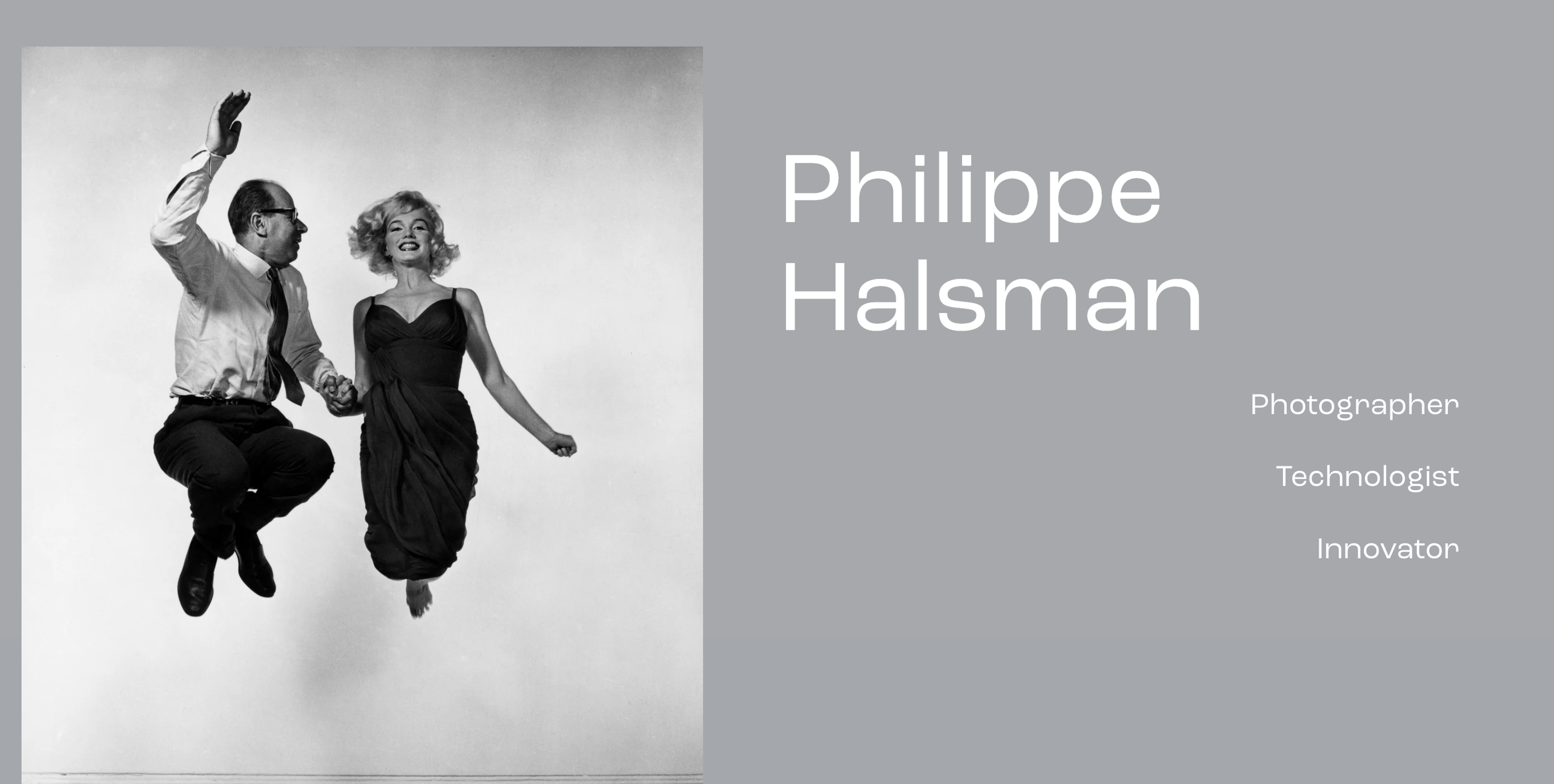

Philippe Halsman
Group of Starlets and Marilyn Monroe
- PhotographerPhilippe Halsman
- CourtesyPhilippe Halsman, © Philippe Halsman Archive
Frederic Aranda In my many experiments with group portraits over the years, I often think back to this interesting and highly interactive shoot by Philippe Halsman. In 1949, Life Magazine sent Halsman to Hollywood to photograph eight young, aspiring actresses using his preferred twin-lens reflex camera. The feature was called "Eight Girls Try Out Mixed Emotions" and included an introductory group portrait followed by individual shots of each actress responding to different scenarios set by the photographer. The sitters were Marilyn Monroe and Cathy Downs on the floor, Laurette Luez, Jane Nigh and Dolores Gardner in the middle row, and Lois Maxwell, Suzanne Dalbert, and Enrica (Rick) Soma in the top row…
View the original photograph "Group of Starlets and Marilyn Monroe" on Philippe Halsman Archive
Frederic Aranda's Perspective on Philippe Halsman
… The group portrait set the tone of the piece with the young women performing their public, professional "starlet" persona: they are posed, styled, smiling and projecting the glamour required of a contract player in 1949 Hollywood, capturing how they presented themselves to the world when the camera was pointed at them as a group. Their demeanour is polished and intentional with some actresses projecting a sharp, traditional pin-up intensity or a rigid, practiced smile, yet Marilyn stands out for appearing entirely at ease in her own skin, sitting naturally on the floor without competing for the loudest pose. Her expression is softer, slightly dreamy, and profoundly open to the lens. As an overall group portrait, it feels fluid despite being tightly packed; the dynamic lines running through the image give each woman the space to shine individually. It also feels cohesive as a group as if the planets had aligned while the shutter was released for 1/125th of a second.
For the individual portraits, Halsman had each actress individually act out four distinct make-believe scenarios: The approach of a monster, reacting to a funny story, embracing a lover, and sipping a favourite drink. Life printed these individual reaction shots arranged in a grid style alongside the main group portrait so readers could compare how each girl performed. By forcing identical prompts onto eight different subjects, Halsman turned the page layout into a controlled optical experiment where the variable wasn't the lighting or the focal length, but the raw, unmetered psychological response of the human subject. Marilyn's performance is a case study of how an exceptional subject treats the camera as an active participant rather than a passive recording device.
Perhaps the most interactive aspect of the shoot was that Life also included a reader's response column inviting the public to look at the various photos and predict which of the eight young women had the star power to "make it" in Hollywood. Interestingly, we are told that only one single letter-writer correctly predicted that Marilyn Monroe would become the breakout superstar of the group. Three years later however, when Life wanted to do a story on a rising Hollywood talent, Halsman immediately remembered her from their "Mixed Emotions" session and personally suggested her to the editors. The editors loved his portraits so much that they placed Marilyn on the cover of Life in 1952.
From Paris to LIFE
Philippe Halsman’s approach to portraiture was shaped by a fascination with what lies beneath a person’s public appearance. Born in Riga in 1906, he initially studied engineering in Dresden before moving to Paris and turning decisively towards photography. His technical background remained an important part of his practice, but it was the human face that became his central subject. He was interested in photography as a way of revealing something about character rather than simply recording likeness.
After establishing his reputation in Paris during the 1930s, Halsman fled Europe during the Second World War and arrived in New York in 1940. Within a few years, he had established himself among America’s leading magazine photographers. His relationship with LIFE became particularly significant: over the course of his career, he produced 101 covers for the magazine, photographing an extraordinary range of cultural and political figures, from Albert Einstein and Winston Churchill to Audrey Hepburn and Salvador Dalí.
Photography as Experiment
Experimentation was central to Halsman’s practice. His background in engineering informed his interest in optics, cameras and lighting, while his work with performers and public figures encouraged him to explore photography as an active exchange between photographer and sitter. Rather than treating the camera as a passive recording device, he used direction, conversation, movement and constructed situations to influence what appeared in front of the lens. His twin-lens reflex camera, which allowed him to maintain eye contact with his subjects while photographing them, became an important part of this approach.
Beyond the Famous Face
Halsman’s career ultimately became a sustained investigation into portraiture itself: how a photograph can suggest personality, mood and interior life within the limits of a single frame. This interest extended far beyond celebrity photography, informing his portraits of artists, scientists, writers and political figures, as well as his more experimental work with Salvador Dalí and his later “jumpology” series. The 1949 Mixed Emotions assignment belongs to this broader body of work, offering an early example of Halsman’s enduring interest in what happens when the conventions of portraiture are deliberately put under pressure.