
Benjamin Degen
Hearth
- ArtistBenjamin Degen
DUSTIN YELLIN Warm up your feet
Where the Familiar Begins to Fracture
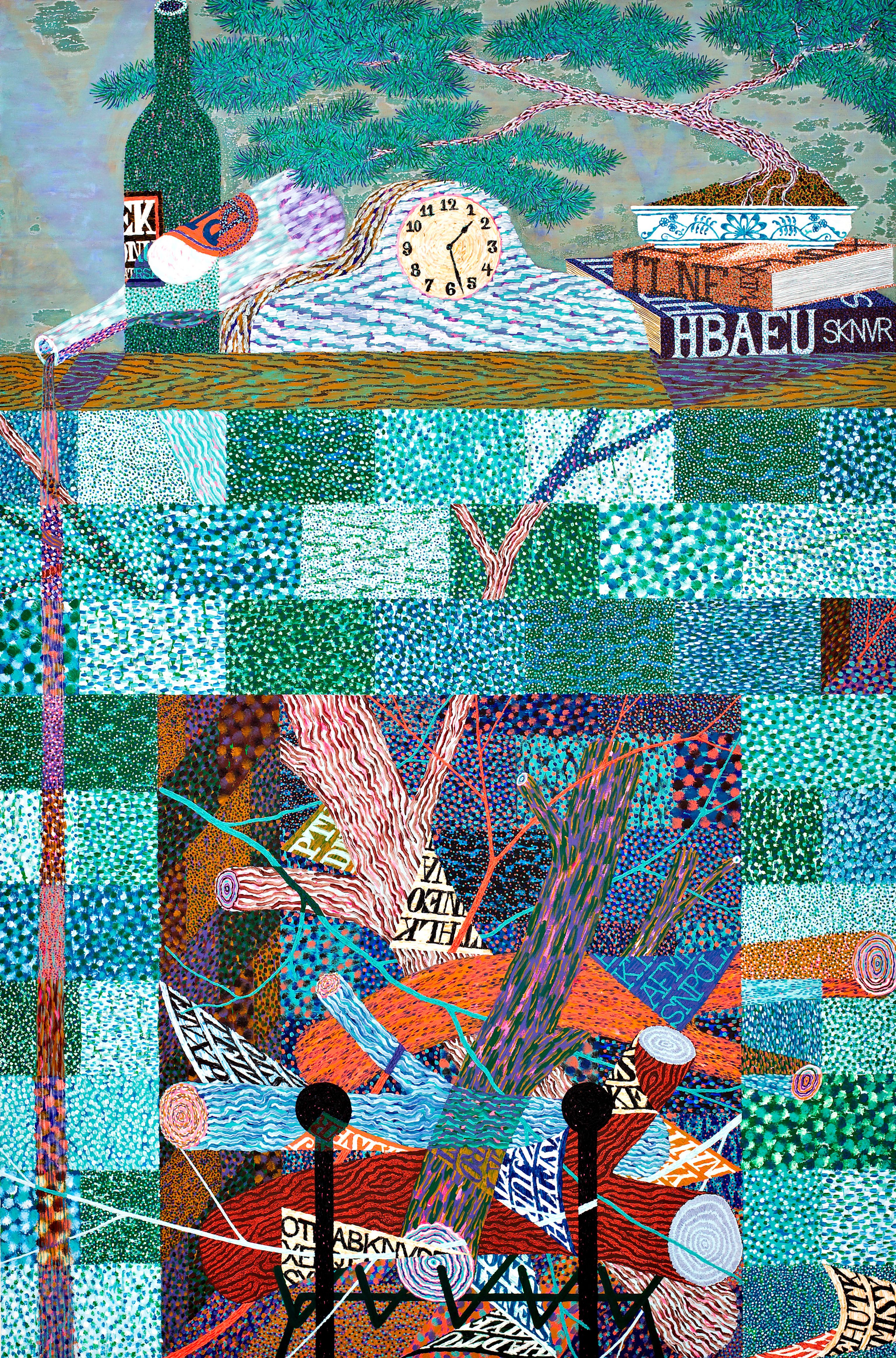
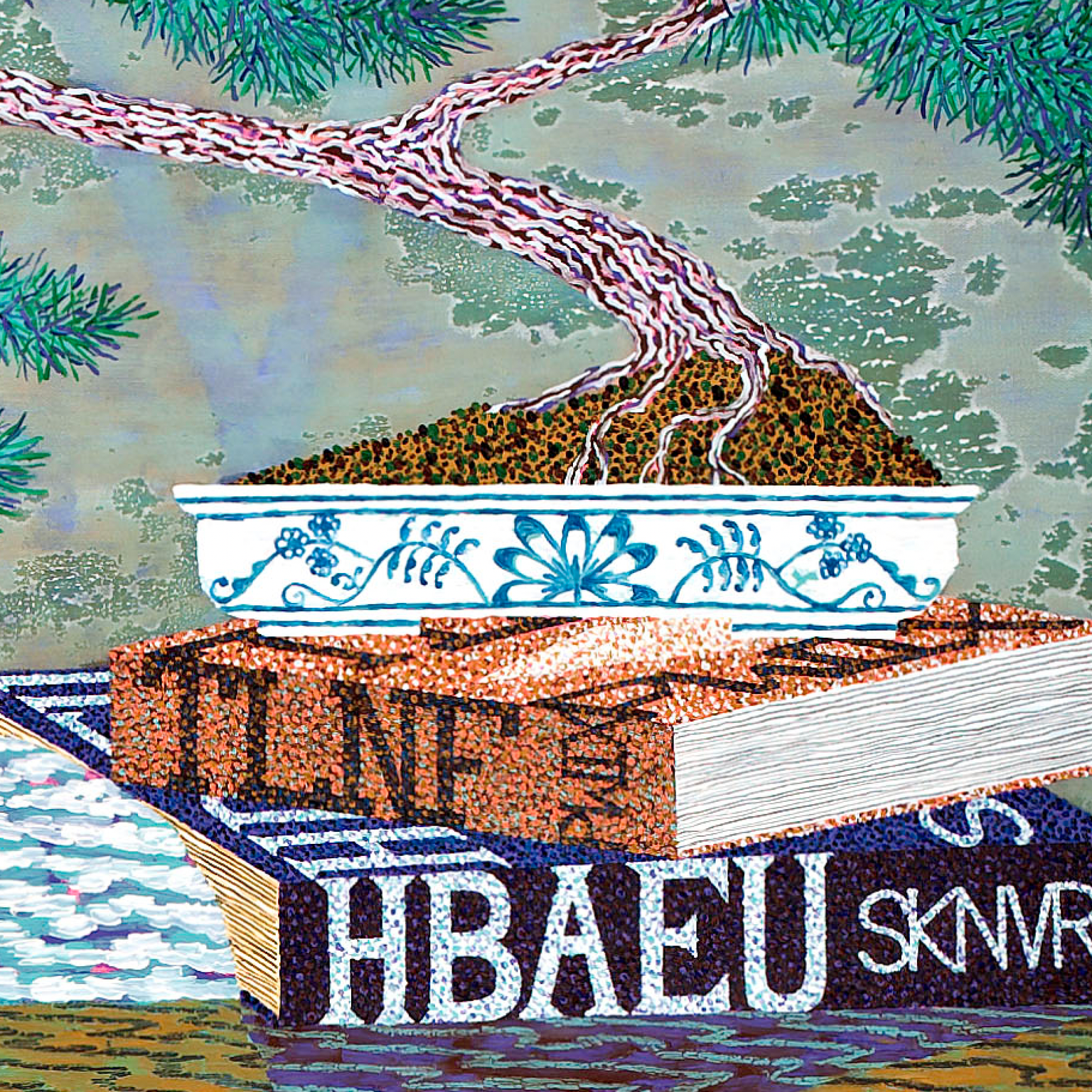
Benjamin Degen’s Hearth unfolds like a layered memory rather than a single, fixed scene. At first glance, it presents a tabletop arrangement: a bottle, a tipped cup, a soft, melting clock, and a bonsai perched on books. But the longer you look, the less stable that arrangement becomes. The surface dissolves into a dense mosaic of patterns, fragments, and textures that seem to slip between representation and abstraction. What appears domestic and familiar begins to feel symbolic, even unsettled.
A Still Life That Refuses Stillness
Degen draws from the tradition of still life painting, yet he resists its usual sense of order and permanence. The objects in Hearth do not simply sit in space; they seem to drift, spill, or morph into their surroundings. The clock sags as if time itself has softened. Liquids pour without clear gravity. The bonsai, typically a symbol of careful cultivation, hovers above a stack of books that hint at knowledge or constructed meaning. These elements suggest a quiet tension between control and entropy, between the human desire to arrange the world and the inevitability of its unraveling.
The title Hearth traditionally evokes warmth, home, and stability. Yet here, the “hearth” is fragmented, dispersed across a patchwork of visual information. Rather than a single grounding center, we encounter multiple competing focal points. It is as if the idea of home has been stretched across memory, perception, and time.


Pattern as Language and Disruption
One of the most striking aspects of the work is its intricate surface. Degen builds the image through countless small marks and repeating patterns, creating a shimmering, almost textile-like effect. These patterns do not merely decorate the scene; they actively disrupt it. They flatten space, obscure edges, and blur distinctions between objects and background.
This visual strategy invites a different kind of looking. Instead of reading the image from foreground to background, the viewer is pulled into a continuous field where everything is equally active. The eye wanders, gets lost, and reorients. In this sense, pattern becomes a language of instability, suggesting that perception itself is layered and unreliable.
At the same time, the patchwork quality evokes quilting or collage, practices associated with assembling fragments into a coherent whole. Yet Degen stops short of full coherence. The pieces never quite settle into a unified narrative, leaving the viewer suspended between recognition and abstraction.
Fragments of Time and Thought
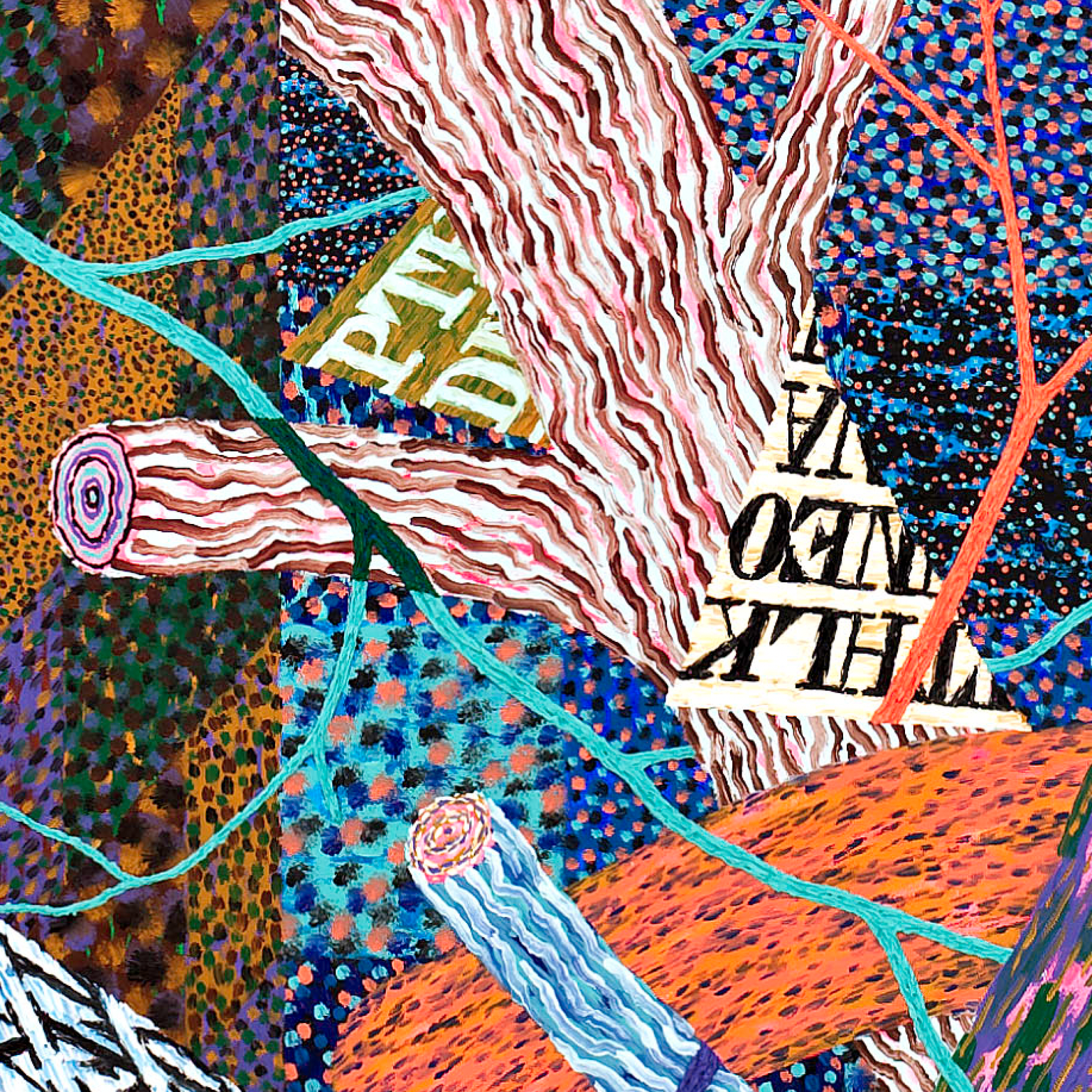
Beneath the tabletop, the composition opens into a more chaotic, almost subterranean space filled with branches, cut logs, and scattered typographic elements. This lower register feels like a subconscious counterpart to the ordered still life above. Words appear partially visible, cut off, or reversed, hinting at meaning without fully delivering it.
This layering suggests that Hearth is not just about physical objects but about the accumulation of experiences, thoughts, and memories. The painting becomes a kind of visual archive where different temporalities coexist. The melting clock reinforces this idea, pointing to time not as linear but as something that folds, stretches, and overlaps.
In this way, Degen’s work resonates with a broader contemporary concern: how to represent a world saturated with information and fragmented by constant shifts in perspective. Hearth does not offer clarity or resolution. Instead, it embraces complexity, inviting viewers to navigate its dense surface and construct their own pathways through it.
The result is a work that feels both intimate and expansive. It begins with the suggestion of a home, a place of gathering, but ultimately expands into a meditation on perception, memory, and the fragile structures we build to make sense of our surroundings.