
Simon Norfolk
Karakaj Aluminium Factory Complex – Bosnia
- PhotographerSimon Norfolk
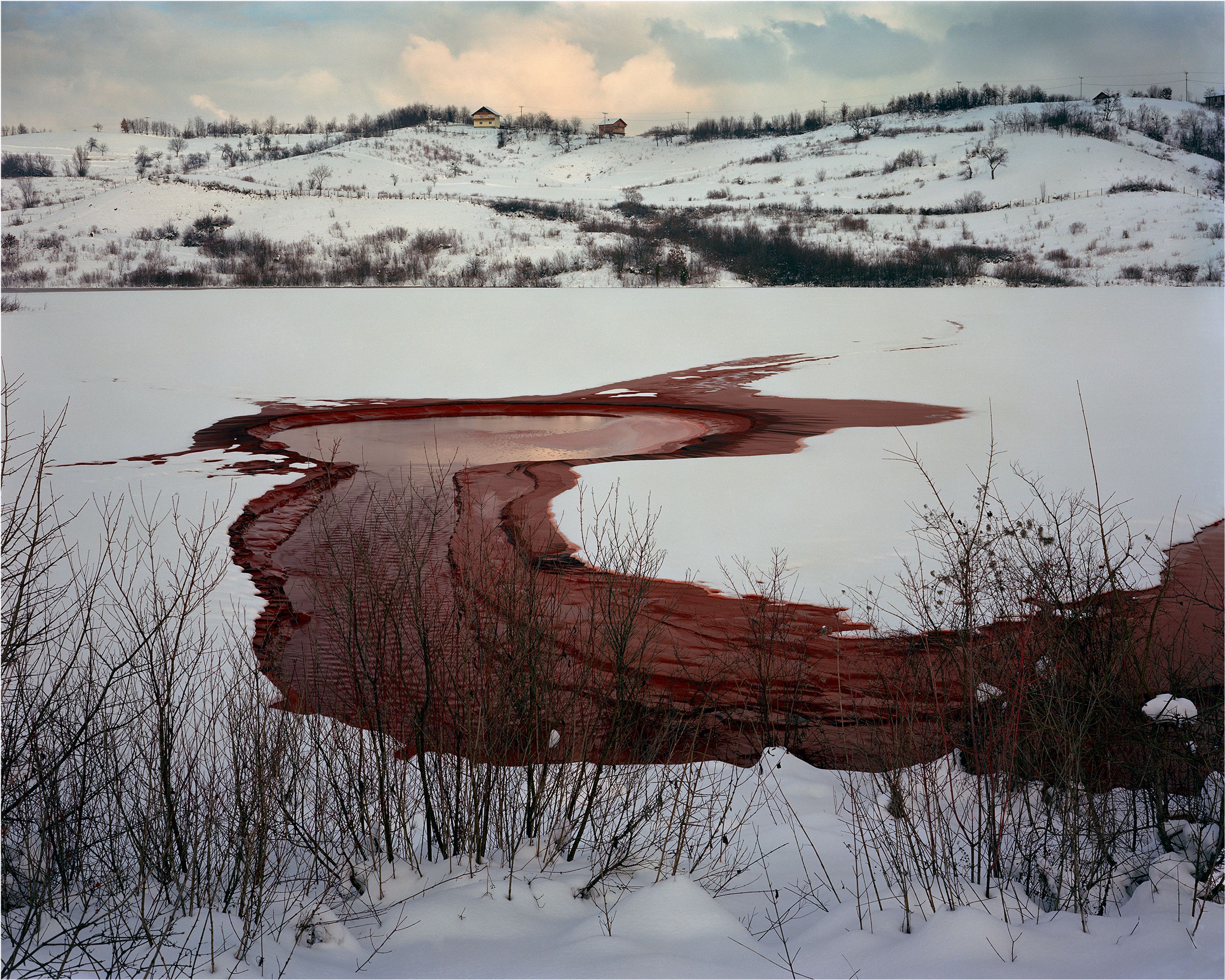
Edmund Sumner In Simon Norfolk’s “Karakaj aluminium factory complex” a lake sits quietly within a field of snow and red earth. At first, it reads as landscape - still, almost abstract. Almost bleeding. Only later do you learn what happened there during the Bosnian War - that hundreds of young men were murdered, their bodies disposed of in the lake. Again, the image remains the same. But its meaning shifts, deepens, darkens. Photography does not change the past - but it reveals the traces that allow us to feel it.
Bleed
Simon Norfolk’s Karakaj Aluminium Factory Complex forms part of his broader project Bleed, a body of work that traces the physical aftermath of war in Bosnia. The photograph focuses on an aluminium waste pond at the Karakaj industrial site near Petkovici, a surface that reads at first as abstract, almost painterly in its dense red coloration and still, mirror-like presence. But the image is inseparable from what happened here: on 14 July 1995, hundreds of Bosniak Muslim men and boys were forced into trucks and brought to this industrial complex, where they were executed. Some of their bodies are believed to have been disposed of in the pond itself, while others were buried in mass graves nearby.
The photograph holds this history without directly showing it, allowing the landscape to carry the weight of what cannot be re-staged.
Industrial Surface, Hidden Grave
What makes the image so unsettling is its refusal to behave like a conventional documentary record. Norfolk does not present bodies, ruins, or immediate destruction. Instead, he isolates a residual surface – an industrial waste pond – that becomes a kind of latent archive. The viewer is confronted with a material that is both banal and symbolic: a byproduct of aluminium production transformed into a site of alleged disposal for human remains. In this tension between function and implication, the photograph exposes how industrial systems and acts of violence can become physically entangled. The calmness of the composition only intensifies the historical violence embedded within it, as if the landscape itself has absorbed the event and refuses to release it in clear narrative form.
The Afterlife of Conflict
Within Bleed, Norfolk extends his investigation of how war persists beyond the moment of violence, settling into terrain, infrastructure, and everyday geography. The project moves through Bosnia’s post-war landscape, where the traces of conflict are often indirect, dispersed, or partially erased. Rather than focusing on battlefields, Norfolk turns to sites where violence has been processed, hidden, or absorbed into industrial and civic systems. The Karakaj image becomes emblematic of this approach: a place where atrocity and industry overlap, and where the consequences of war continue to circulate beneath the surface of ordinary material reality.
Norfolk’s method is deliberately restrained, using large-format precision and a calm visual language that resists the immediacy of news photography. This distance is not neutrality, but a way of slowing down how we read evidence. In Karakaj Aluminium Factory Complex, the horror is not staged or dramatized; it is inferred through context, research, and the unsettling beauty of the image itself. The result is a photograph that asks the viewer to stay with ambiguity, to consider how violence can be present even in silence, and how landscapes can hold histories that are no longer visibly there, but not gone.