
Enric Miralles and Carme Pinós
Olympic Archery Range
- ArchitectEnric Miralles and Carme Pinós
- PhotographerCourtesy of Miralles Tagliabue – EMBT Architects. Photo by Hisao Suzuki
Isaac Michan and Alexandra Bové The Archery Range project dissolves into the landscape while still maintaining a powerful architectural presence. Its fragmented geometry, shifting levels, and material roughness create a constant dialogue between movement, terrain, and structure.

Drawn Into the Hills
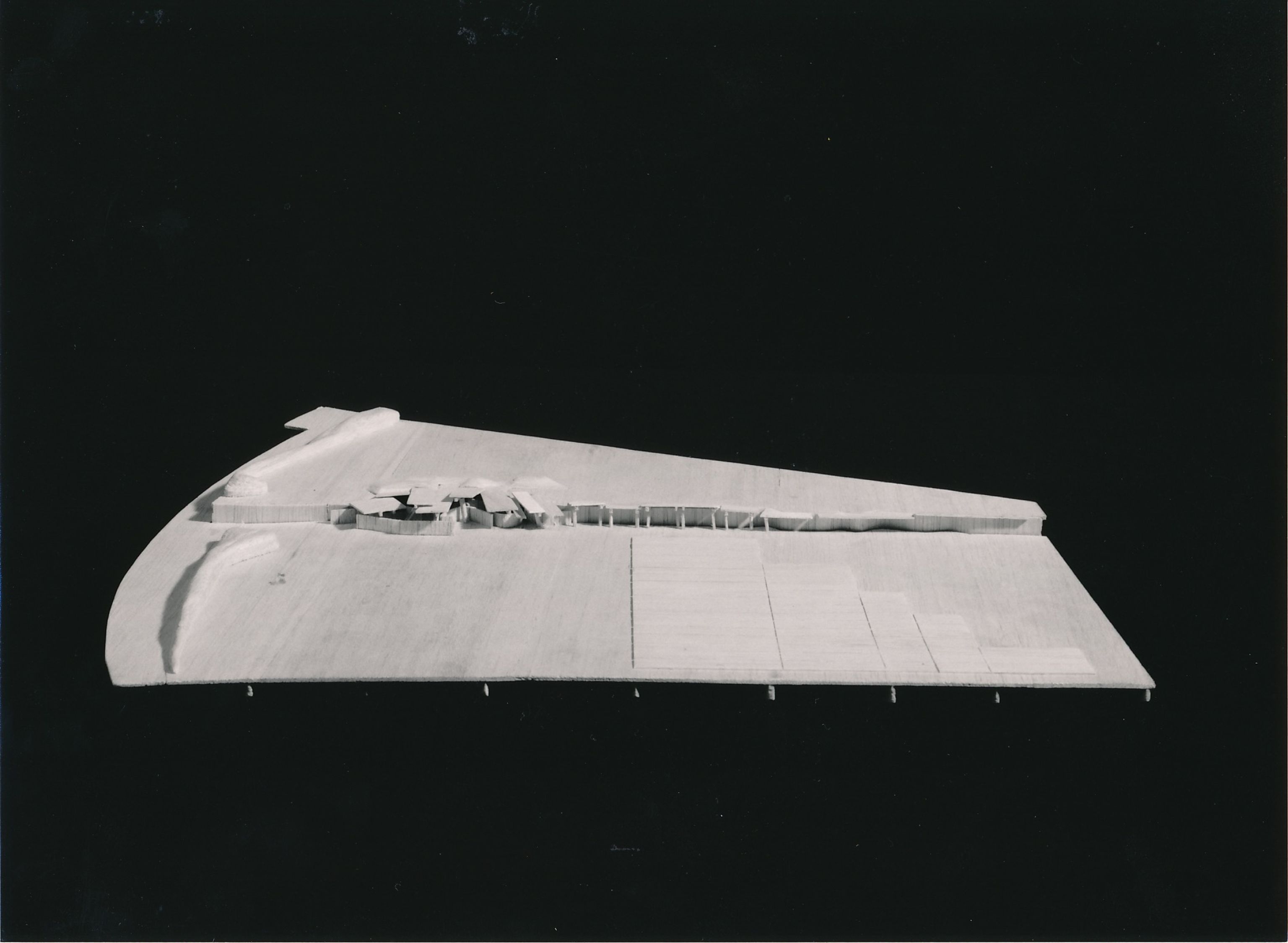
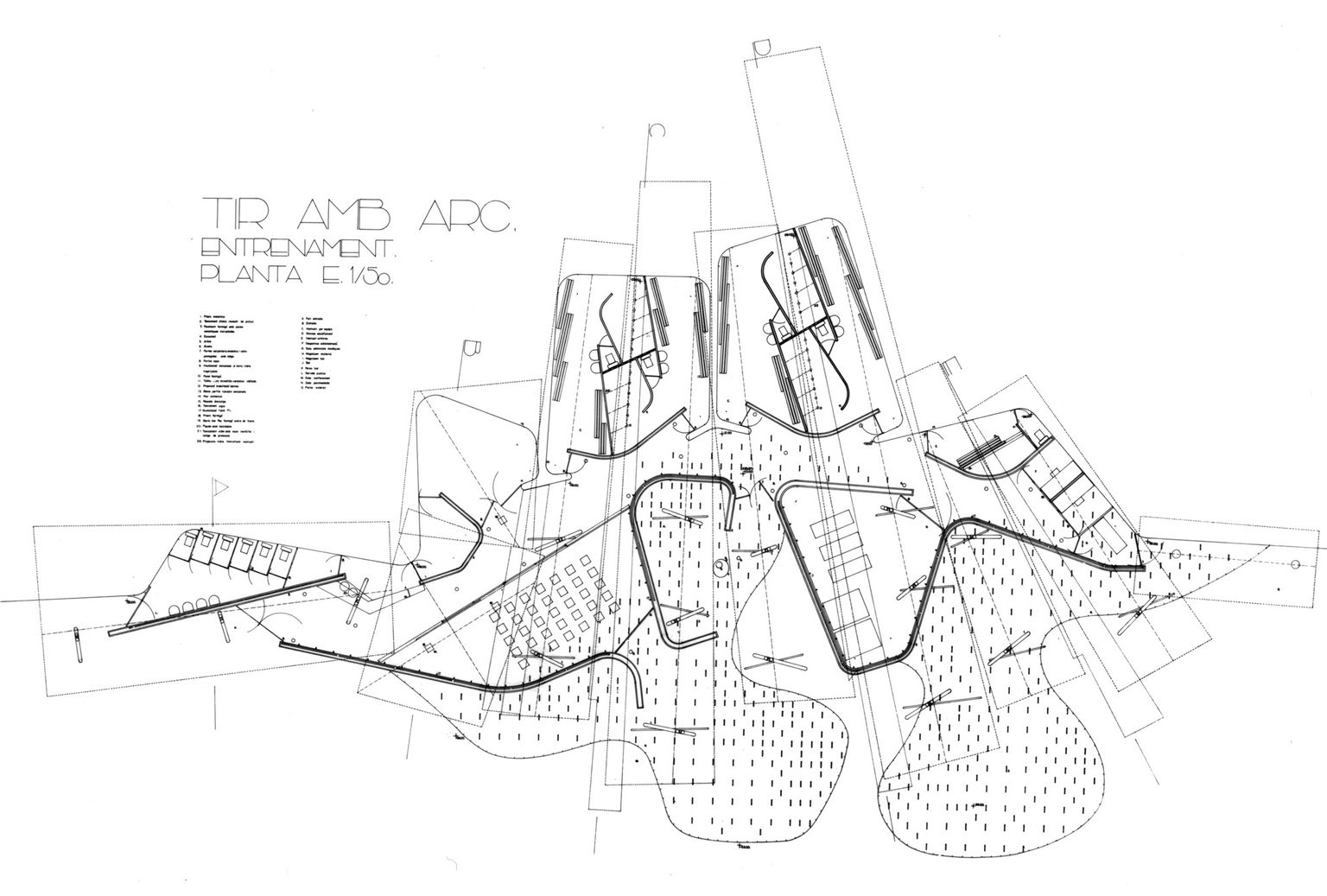
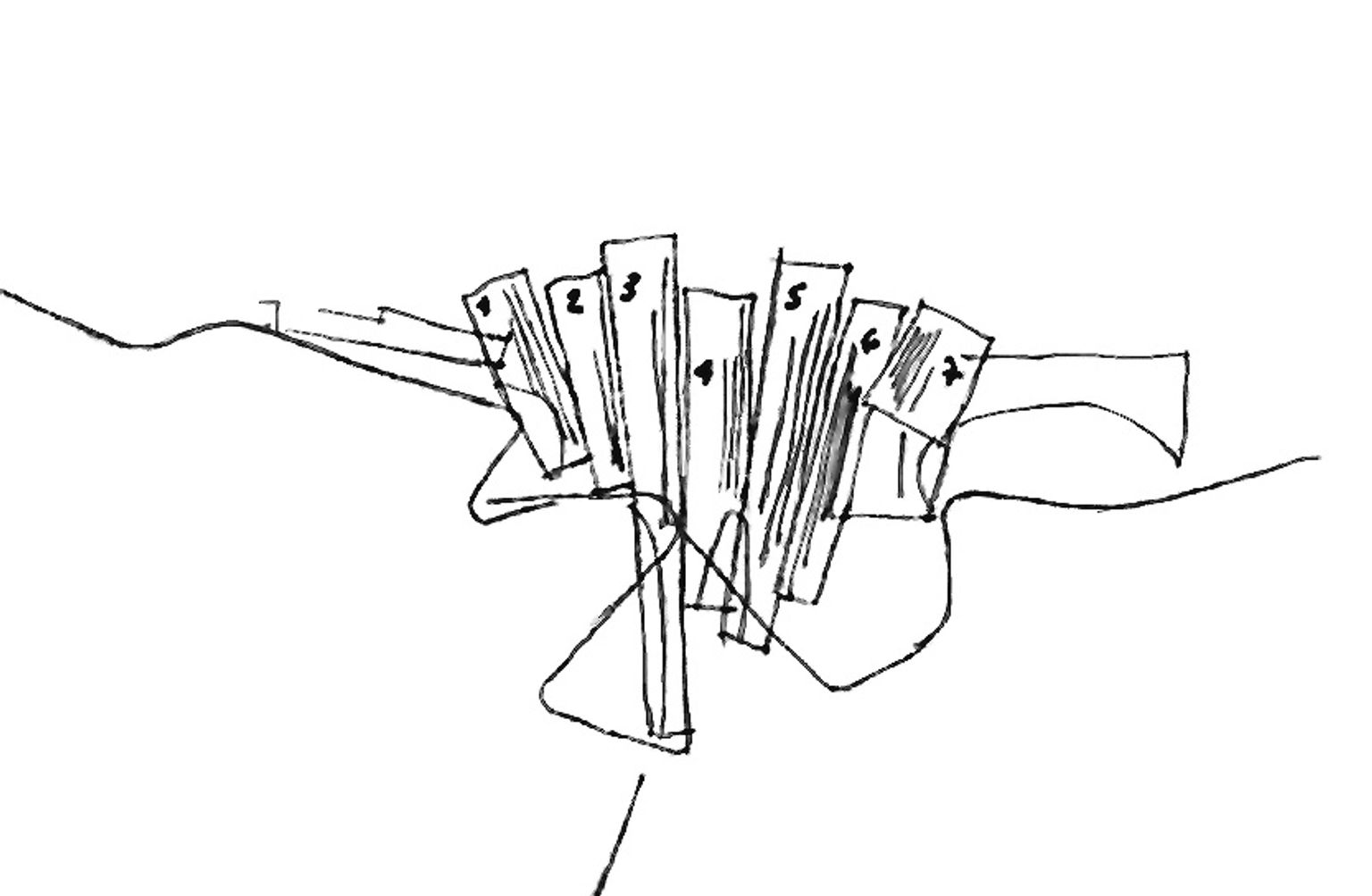
Designed for the 1992 Barcelona Olympics and completed in 1991, the Olympic Archery Range marked a breakthrough moment for Enric Miralles and Carme Pinós. Located in the hilly district of La Vall d’Hebron, the project transformed a former athletic ground into a striking architectural landscape shaped specifically for archery. Before most people ever visited the site, the project had already become famous through its drawings, layered plans filled with fractured geometries, curved lines and shifting spatial rhythms that revealed the architects’ highly experimental approach. At a time when much contemporary architecture still relied on rigid order and repetition, Miralles and Pinós proposed something far less predictable.
The project refused the idea of architecture as a clean object placed onto a site. Instead, the buildings unfolded directly from the existing conditions around them, creating spaces that felt embedded within the terrain rather than imposed upon it.

The Competition Pavilion
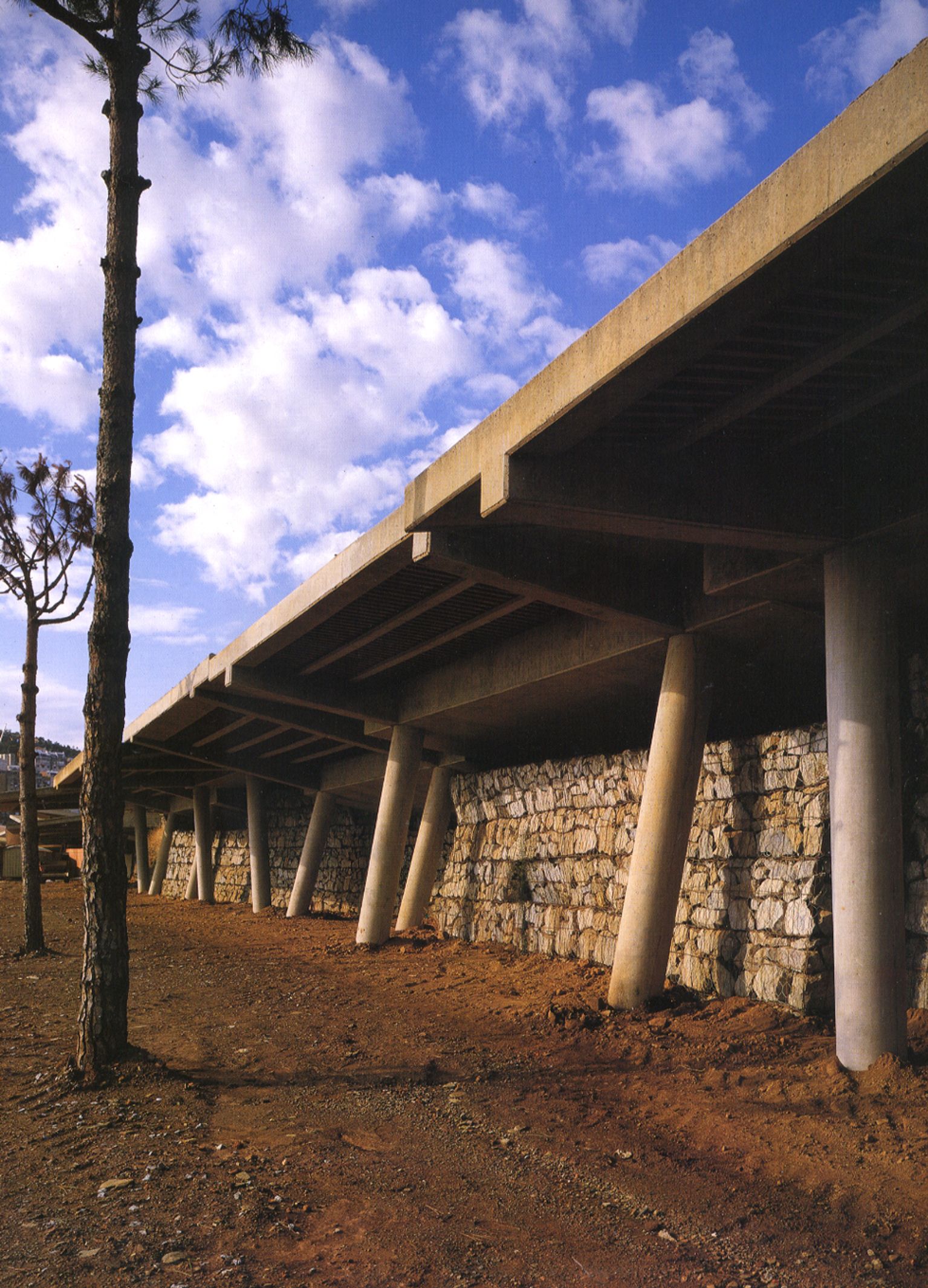
The competition pavilion was organised around two main elements: a retaining structure pressed into the slope and a long exposed concrete wall system facing the shooting range. The architects developed the building through studies of the site’s contour lines, allowing the geometry of the pavilion to emerge from the existing topography rather than from a fixed grid. The result feels fragmented yet carefully controlled, with walls, pathways and openings shifting direction across the site. Natural light became one of the pavilion’s defining materials.
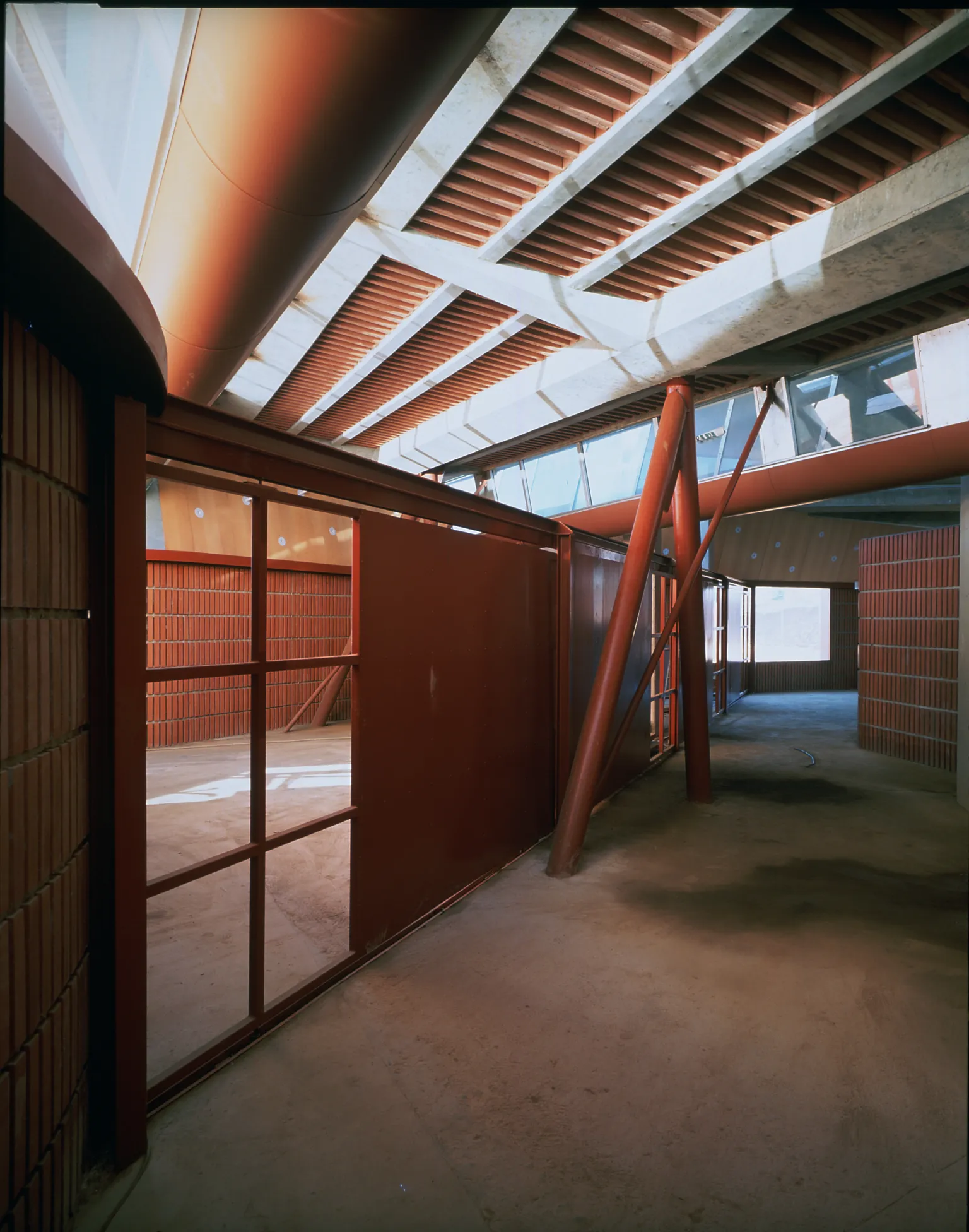
Repeating prefabricated concrete panels were perforated with circular and triangular openings that filtered sunlight into the interior, creating constantly changing patterns across the raw concrete surfaces. Louvers and roof screens moderated the exterior light differently, adding another layer of texture and depth to the building. Even with its heavy material palette, the pavilion never feels static; every surface seems activated by shadow, movement and changing perspectives.

The Training Pavilion
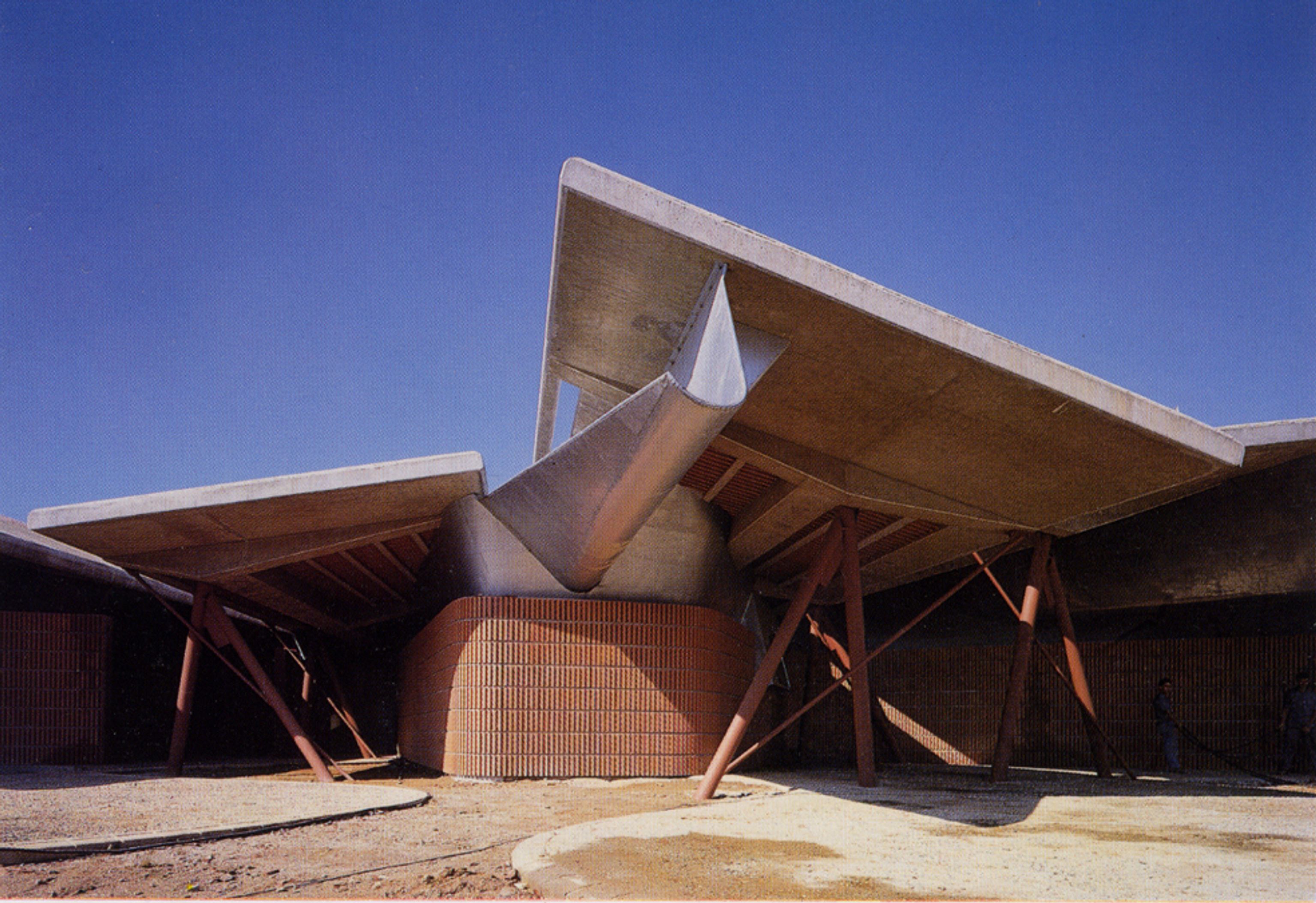
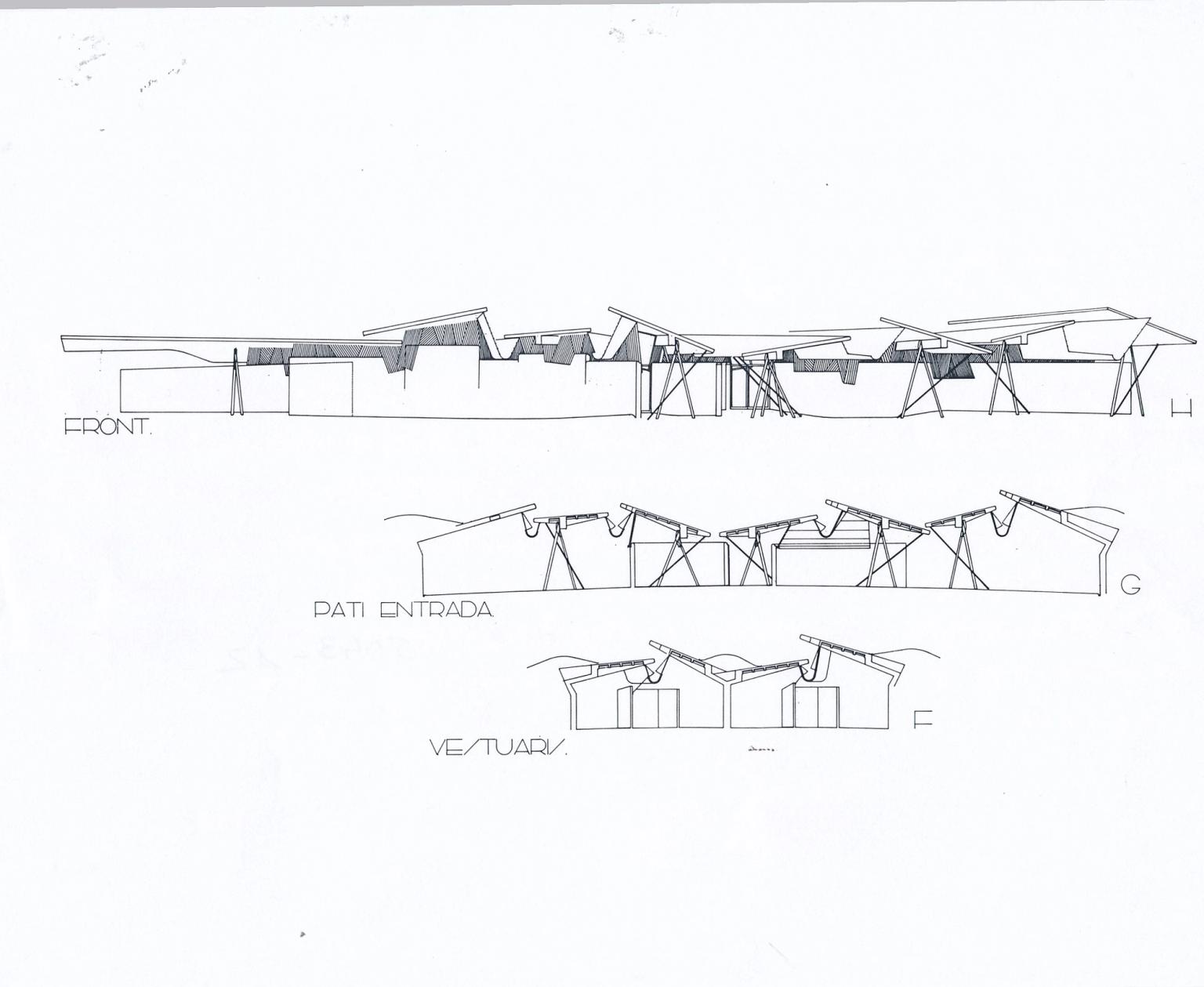
Where the competition pavilion responded closely to the ground, the training pavilion focused on direction and momentum. Long projecting roof slabs extend outward over the shooting spaces, giving the structure a sharp linear energy often compared to arrows released from a bow. The roof planes tilt and lift at different angles, opening narrow clerestory gaps that pull light deep into the building while intensifying its dynamic silhouette. Inside, the plan combines curved and rectilinear geometries in ways that feel intuitive rather than systematic, accommodating changing rooms, storage areas and training facilities within an unusually fluid spatial sequence.
Miralles and Pinós avoided clear hierarchies or monumental gestures; instead, the architecture develops through tension between structure, circulation and light. Even today, the pavilion retains a sense of movement, as though the building itself were caught mid-action.


Prefabrication as Architecture
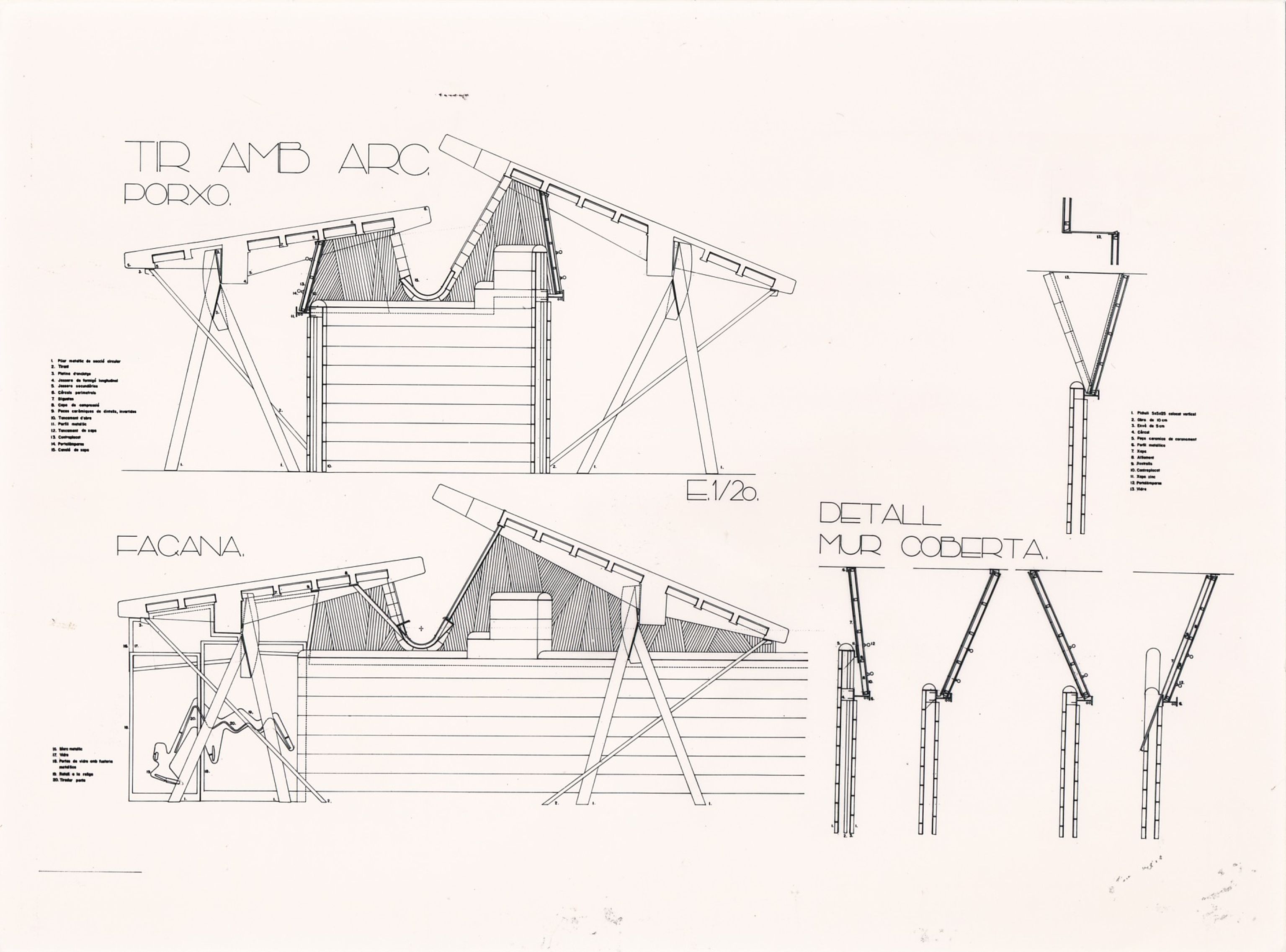
Because the commission arrived only shortly before the Olympic Games, the project demanded an extremely fast construction process. Rather than compromising the design, Miralles and Pinós used the time pressure to experiment with prefabrication in a new way. The repeated concrete modules were designed not simply for efficiency, but as architectural elements capable of generating rhythm, transparency and atmosphere.
Their approach rejected the polished perfection usually associated with modular systems. Surfaces remained rough, joints visible and textures intentionally coarse. This interest in expressive prefabrication was closely connected to the architects’ simultaneous work on Igualada Cemetery, where concrete elements were also used to create emotional and spatial intensity rather than neutrality. In both projects, construction methods became part of the architectural language itself, less about industrial repetition and more about producing variation, depth and material presence.

Enric Miralles and Carme Pinós
The Olympic Archery Range was created during the most celebrated period of collaboration between Enric Miralles and Carme Pinós, who worked together from 1982 until 1991. Both educated at the ETSAB in Barcelona, they emerged as central figures within a new generation of Spanish architects following the Franco era. Their work combined technical precision with a highly personal and expressive architectural language shaped by landscape, structure, memory and movement.
Miralles, born in 1955, became internationally recognised for projects that resisted stylistic classification, drawing influence from figures such as Alvar Aalto, Louis Kahn and Spanish modernists including Alejandro de la Sota and Josep Maria Jujol. Pinós brought an equally rigorous spatial and structural clarity to the partnership, helping shape some of the studio’s most important works, including Igualada Cemetery and La Llauna School. Together they developed buildings that felt simultaneously experimental and deeply rooted in place, balancing complexity with extraordinary spatial sensitivity.

After the Arrows
Although the project became one of Barcelona’s most celebrated Olympic works, part of it no longer survives. Years after the Games, the competition pavilion was dismantled during the expansion of the city’s Metro system, leaving only the training pavilion still standing today. Yet the influence of the project extends far beyond its physical condition. The drawings, models and photographs produced by Miralles and Pinós continue to circulate widely within architectural culture, not simply as representations of a building, but as documents of an entirely different way of thinking about design.
More than thirty years later, the Olympic Archery Range still feels remarkably contemporary in its rejection of rigid systems and its ability to create architecture through atmosphere, geometry and spatial experience rather than formal spectacle alone.