
Paul Rudolph
The Colonnade Condominiums
- ArchitectPaul Rudolph
- PhotographerPhilippe Lê
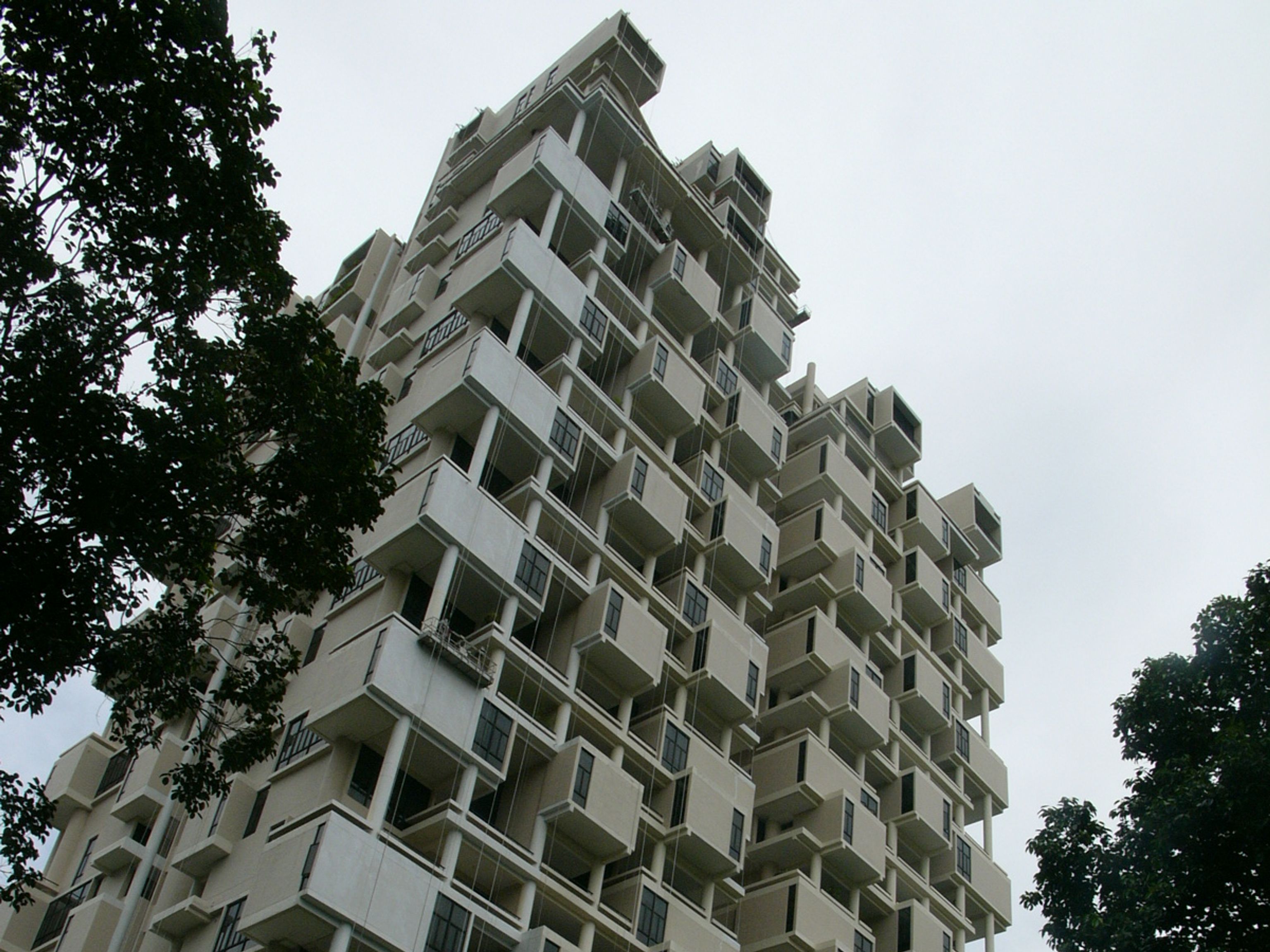
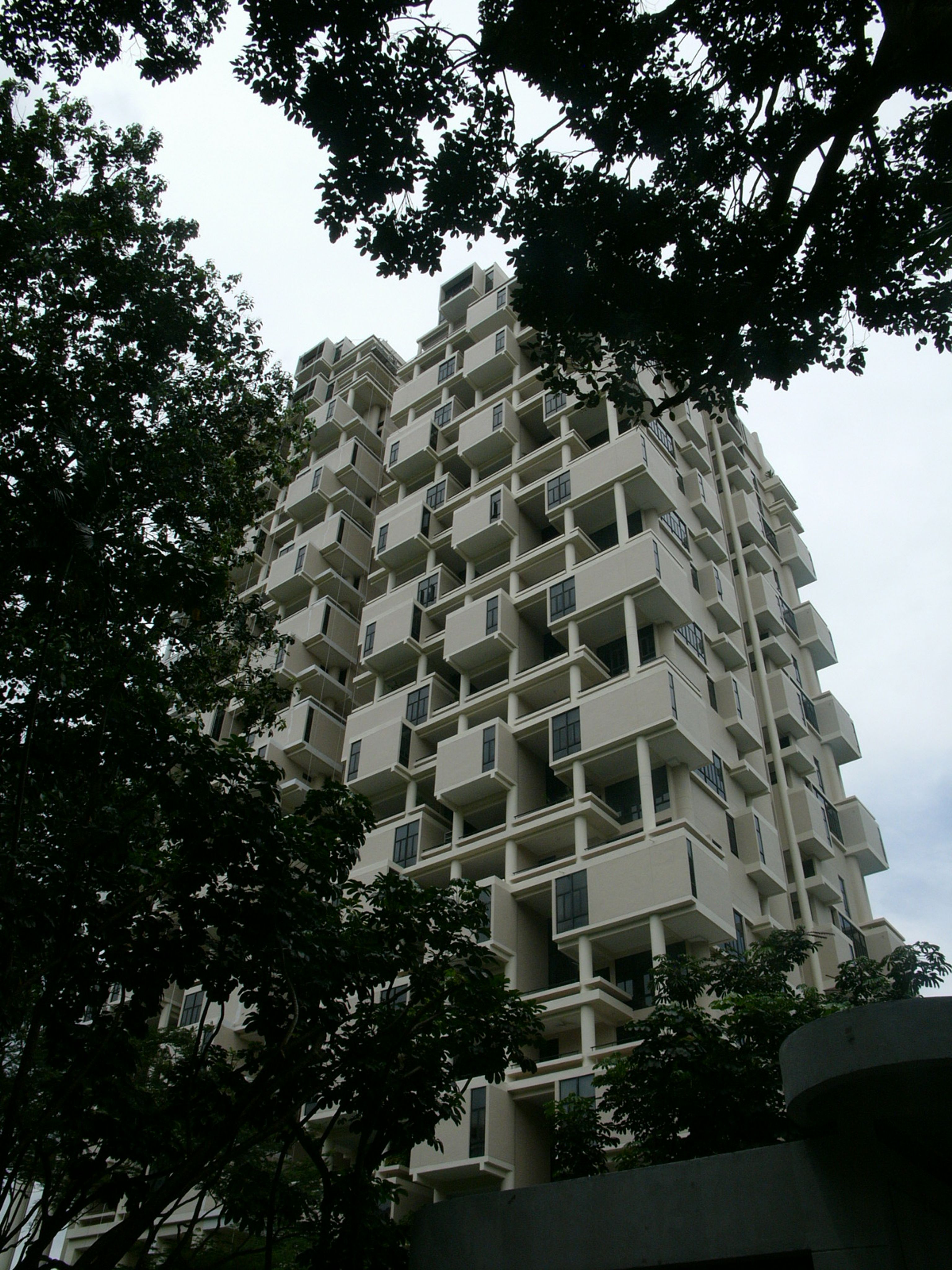
Philippe Lê Paul Rudolph has been a pioneer for the brutalist movement and this less known project is the perfect illustration of his mastery of volumes, it appears like a stack of houses and is perfectly adapted for life in Singapore and its tropical climate.


The Colonnade Condominiums: Context and Architectural Ambition
Designed by American modernist Paul Rudolph and completed in 1986, The Colonnade Condominiums at 82 Grange Road stand as one of Singapore’s most radical residential experiments of the late twentieth century. Conceived during the final phase of Rudolph’s career, when he was increasingly working in Asia, the project translates ideas first developed in his unbuilt Graphic Arts Center for Manhattan into a tropical, high-density housing context.
Originally imagined as a megastructure assembled from prefabricated units – what Rudolph famously described as the “twentieth-century brick” – the building reflects his long-standing ambition to combine modular construction with spatial richness. Although technical and financial constraints ultimately led to a cast-in-place concrete solution, the core conceptual framework remained intact, allowing the project to retain the visual and structural power of the original proposal.

Structure, Form, and Urban Presence
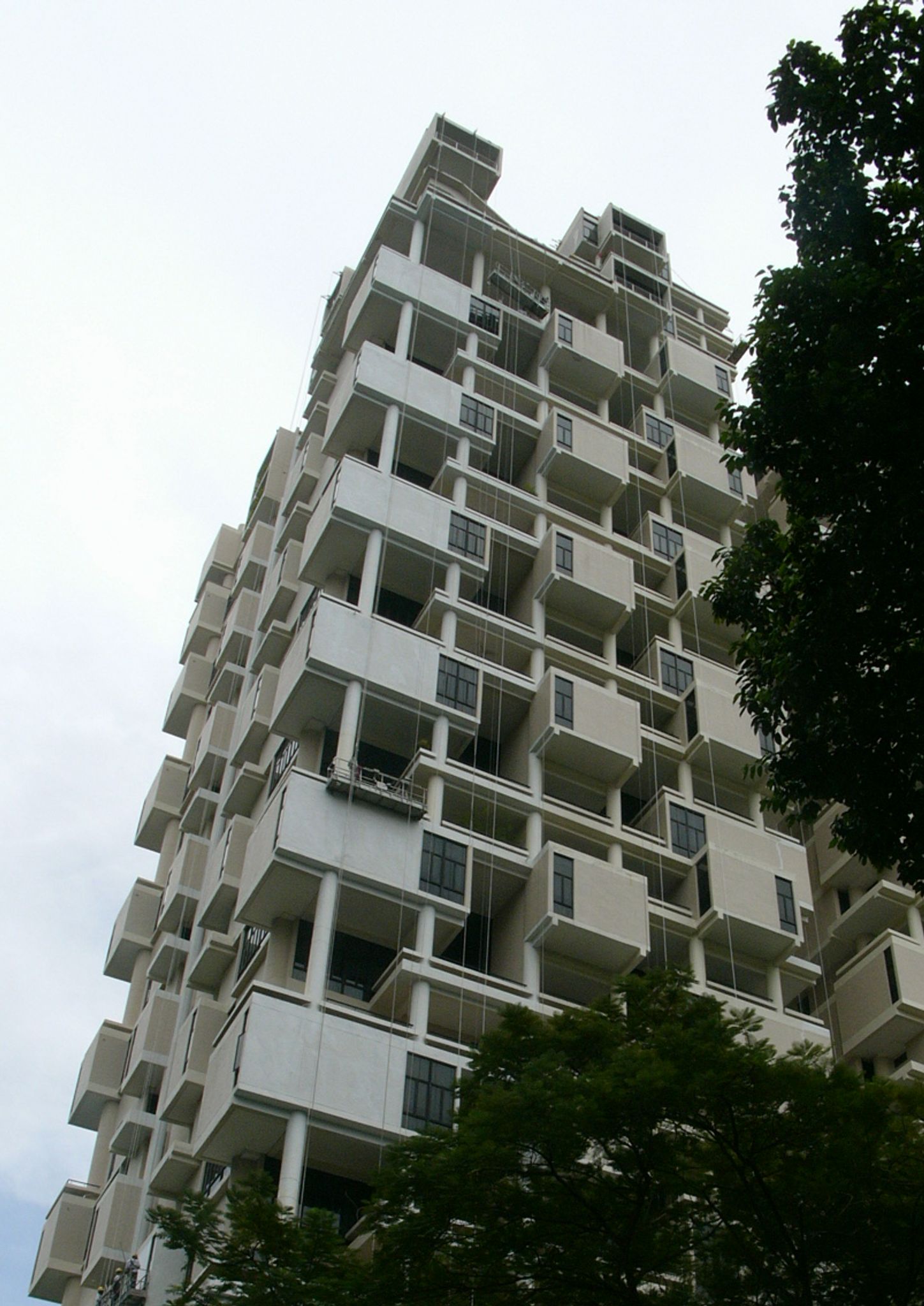
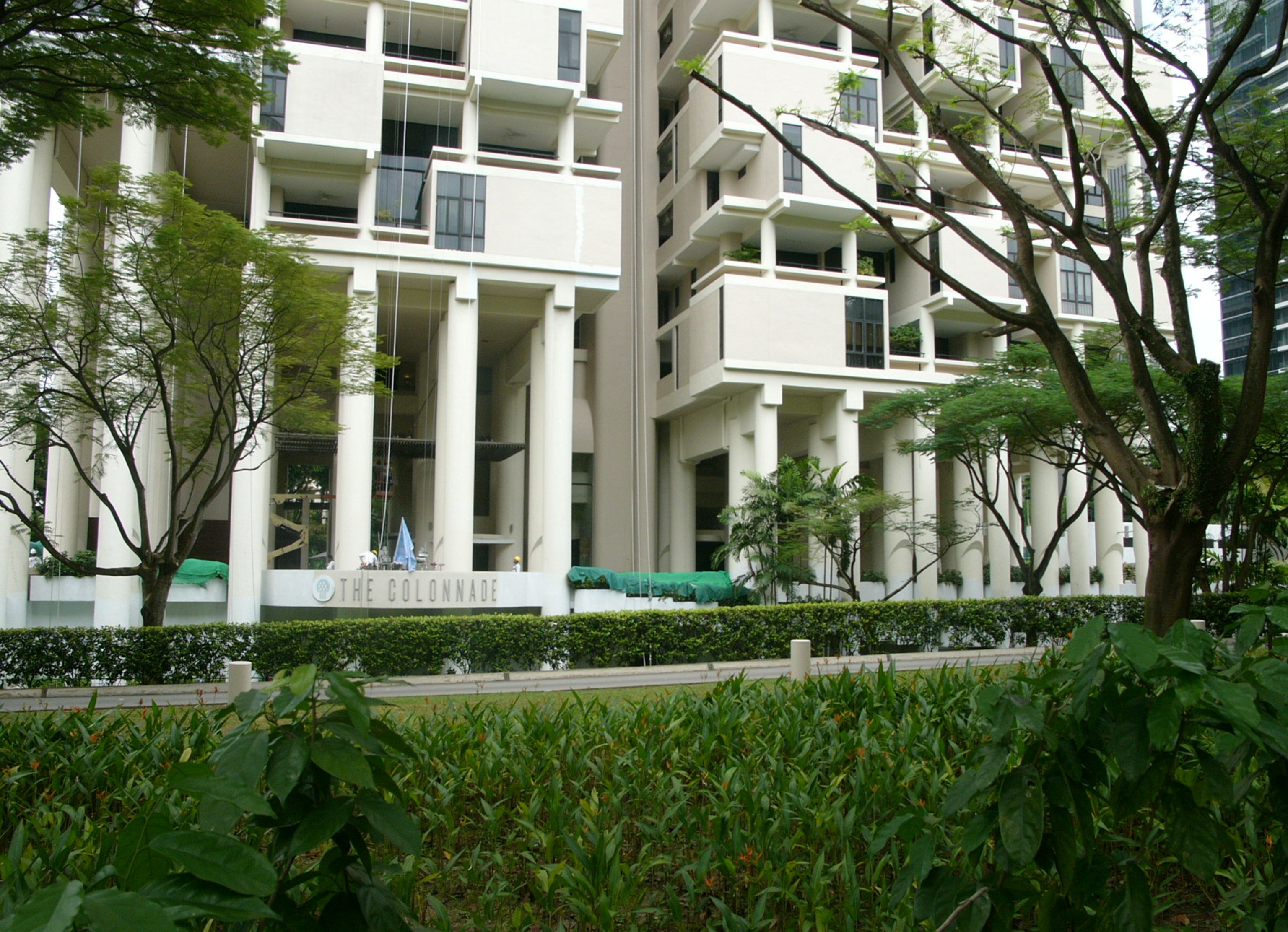
The Colonnade is organized as a single sculptural tower divided into four rectangular quadrants arranged around a central core. At ground level, these quadrants are lifted off the site on two closely spaced rows of round concrete columns, creating a shaded, permeable base that lends the building its name and allows light and air to flow beneath the structure. Each quadrant rises from the ground at a different height, producing shifting floor planes that generate terraces, cantilevers, and deep shadow lines across the façade. This interplay of repetition and variation gives the tower its distinctive rhythm – a stacked composition of projecting volumes and recessed voids that resists the smooth, glassy language of later residential towers. In the quiet, green enclave of Grange Road, the building reads as both a monumental object and a porous structure, suspended above the landscape rather than imposed upon it.
Living Spaces and Climate Response
Inside, the building’s spatial ambition becomes fully legible. The Colonnade contains 90 duplex units, each organized over two levels with double-height living and dining spaces, generous kitchens, and deep inset terraces. Bedrooms are placed on the upper level, often partially shielded from direct sunlight, while the main living areas open outward through expansive glazing.
The layout draws clear precedents from Le Corbusier’s Pavilion de l’Esprit Nouveau, particularly in the stacking of private spaces above communal zones and the use of vertical height to create spatial drama. Crucially, Rudolph adapted these modernist ideas to Singapore’s tropical climate: deep overhangs, staggered balconies, and cross-ventilated units mitigate heat gain while maximizing daylight and views of the surrounding greenery. The result is an environment often described by residents as a “bungalow in the sky,” combining density with openness.

Drawings, Collaboration, and Legacy
The complexity of The Colonnade was matched by the sophistication of its design process. Rudolph employed a wide range of drawing techniques – including plans, sections, perspectives, and axonometric drawings – to communicate the intricate interlocking of units, terraces, and structural frames. These drawings reveal his fascination with inhabited structures, where load-bearing systems are not concealed but become the architectural language itself.
The project was realized in collaboration with a broad international team, including associate architects Chao Tse Ann & Partners and structural engineers Ove Arup & Partners, whose expertise was essential in translating Rudolph’s geometric vision into buildable concrete. Developed by Pontiac Land and completed in 1986, The Colonnade is not formally conserved today, yet it remains one of Singapore’s most distinctive residential buildings – a rare example of modern tropical brutalism that prioritizes spatial generosity, environmental intelligence, and architectural expression in equal measure.